Liang Jiarui
ThinkMachine (thinkmachine.work). Email:
jiarui.liang@thinkmachine.work
Abstract
Mineral processing experiments are costly and limited in number. Reagents, grinding, residence time and process-water ions jointly form a high-dimensional operating space, which makes prediction of flotation and separation performance difficult. Purely mechanistic models often exhibit irreducible mismatch for a given ore; purely data-driven models extrapolate poorly and require many samples. This paper presents a physics-informed hybrid approach that uses a mechanistic model as the backbone, corrects residuals with data while quantifying predictive uncertainty, and places subsequent tests sequentially by the criterion of maximum reduction in prediction variance over the full operating space. We refer to this paradigm as Physical AI for Minerals Engineering. In the process simulator emeisim, an uncalibrated purely mechanistic model retains a root-mean-square error (RMSE) of about 11 percentage points over the operating space. An uncertainty-guided hybrid mechanistic–data-driven model reaches within 3 percentage points in 3 tests, whereas a randomly sampled data-only model requires 8 tests. For a target of 2 percentage points, the hybrid model requires 11 tests, the uncertainty-guided data-only model requires 10 tests, and the randomly sampled data-only model requires 16 tests.
1 Problem
In mineral processing and extractive metallurgy, reagent schemes, grinding fineness, stage residence times and process-water composition (for example, magnesium ion concentration) jointly determine concentrate grade and recovery in flotation and separation circuits. These operating variables are coupled and may constitute a high-dimensional operating space. Laboratory batch tests and continuous scale-up trials consume ore, reagents and analytical resources; they are costly and slow, so the amount of calibration data that is practically available is often very limited. What engineering practice requires is reliable prediction of process responses at untested operating conditions, and decisions on subsequent tests and industrial parameters based on those predictions.
One common route is to build a mechanistic model. First-order flotation kinetics, tanks in series and component mass balances have mature formulations; they are computationally inexpensive and do not require large experimental datasets in advance. For a particular ore or tailings stream, however, the model structure and nominal parameters often deviate from the true process: mineral floatability may be systematically slower or faster, and the strength and saturation behaviour of ionic depression or activation may differ from the assumptions of the formulae. Such structural or parametric mismatch does not disappear merely by increasing the amount of simulation; uncalibrated mechanistic predictions can show persistent bias over the full operating space.
Another route is purely data-driven modelling, in which a statistical or machine-learning model is fitted to experimental observations alone. Such methods usually perform well in the neighbourhood of sampled points, but their ability to extrapolate away from the tested region is limited. If acceptable accuracy is required over the entire operating space, the number of tests needed often exceeds the mineral-processing experimental budget. Under data scarcity, therefore, relying on a mechanistic model alone or on a data-driven model alone is unlikely to satisfy both accuracy and sample efficiency. How to combine physical consistency with predictive accuracy under a limited experimental budget is a central problem in process modelling for mineral processing.
2 Method
To address this tension, we adopt physics-informed hybrid modelling together with sequential experimental design based on predictive uncertainty. We refer to this modelling paradigm—process physics as the backbone, continuously corrected by a small number of measurements—as Physical AI for Minerals Engineering. Conceptually, the method comprises three parts.
First, a mechanistic model serves as the prior backbone. Let the operating condition be \(\mathbf{x}\) (for example, added magnesium ion concentration and separation-stage residence time). The mechanistic model \(f_{\mathrm{mech}}(\mathbf{x};\boldsymbol{\theta})\) supplies the main trend of the process output, where \(\boldsymbol{\theta}\) denotes calibratable parameters (such as floatability multipliers and ionic-effect strengths). Flotation kinetics and mass-balance constraints keep the predictions physically interpretable and provide a globally extrapolable shape.
Second, a data-driven residual (discrepancy) correction is introduced. Observations may be written as
\[y(\mathbf{x}) = f_{\mathrm{mech}}(\mathbf{x};\boldsymbol{\theta}) + \delta(\mathbf{x}) + \varepsilon,\]where \(\delta(\mathbf{x})\) is the systematic discrepancy of the mechanistic model relative to the true process, and \(\varepsilon\) is measurement noise, assumed \(\varepsilon\sim\mathcal{N}(0,\sigma^{2})\). On limited experimental data, the parameters \(\boldsymbol{\theta}\) are estimated first; the discrepancy \(\delta(\cdot)\) is then estimated from the residuals \(y-f_{\mathrm{mech}}(\mathbf{x};\hat{\boldsymbol{\theta}})\). The resulting prediction is
\[\hat{y}(\mathbf{x}) = f_{\mathrm{mech}}(\mathbf{x};\hat{\boldsymbol{\theta}}) + \hat{\delta}(\mathbf{x}),\]together with the predictive uncertainty of \(\hat{y}(\mathbf{x})\), which is used for sequential test selection. The mechanistic term constrains the global form; the residual term absorbs local mismatch, thereby improving accuracy over the full space under sparse data.
Third, sequential experimental design (active learning) is used: under the current model, the next operating point is chosen by the criterion of maximum expected reduction in prediction variance over the full operating space (integrated variance reduction), so that scarce tests preferentially reduce domain-wide error. Relative to random placement, this approach concentrates tests at locations that contribute more to full-space accuracy.
3 Simulation design
To compare modelling and test-selection strategies under controllable conditions, we construct a “true plant versus candidate model” comparison in silico; the comparison is performed in a two-dimensional operating subspace. Process responses are computed with the mineral-processing flowsheet simulator emeisim developed by the authors. The flowsheet recovers fluorite from tailings: roughing flotation is followed by separation flotation, and the performance metric is the CaF2 grade of the fluorite concentrate. Kinetic parameters are illustrative and are used for method comparison rather than for calibrating a particular industrial site.
Beyond the nominal mechanistic model, three discrepancies unknown to the candidate models are introduced into the “true plant”: (1) fluorite flotation rates in both the roughing and separation stages are reduced by 15% relative to the nominal values; (2) magnesium-ion depression is stronger and saturating; (3) the calcite flotation rate in the separation stage is increased by 25%. Candidate models are unaware of these changes during learning and can infer only from noisy experimental observations.
The operating domain is two-dimensional: added magnesium ion concentration 0–4 mmol/L, and separation-stage residence time 0.6–2.0 times the nominal value, discretised on a 25×25 grid. Each test observation is corrupted by measurement noise with a standard deviation of 1 percentage point. The evaluation target is the root-mean-square error (RMSE) of the model against the noise-free true response over the entire operating-domain grid, in percentage points of CaF2 grade. Every method starts from 2 randomly placed tests and then adds tests according to its own rule; each method is repeated independently 50 times, and medians are reported.
Five methods are compared: (1) physics only (uncalibrated), which always uses the nominal mechanistic model; (2) data only (random selection); (3) data only (uncertainty-guided selection); (4) hybrid mechanistic–data (random selection); (5) hybrid mechanistic–data (uncertainty-guided selection). The residual terms in the data-only and hybrid models both use a regression model that provides predictive variance; uncertainty-guided selection uses the same full-space variance-reduction criterion in both cases.
4 Results
Figure 1 summarises the simulation results. Figure 1A shows the response surface of fluorite concentrate grade for the “true plant” as a function of added magnesium ion and separation-stage residence time, with one set of five test locations marked; Figure 1B shows the absolute-error maps of the data-only, physics-only and hybrid mechanistic–data models under the same five tests; Figure 1C shows RMSE over the full operating space versus the number of tests (curves are medians over 50 repeats; bands are interquartile ranges); Figure 1D shows the number of tests required to reach preset error targets.
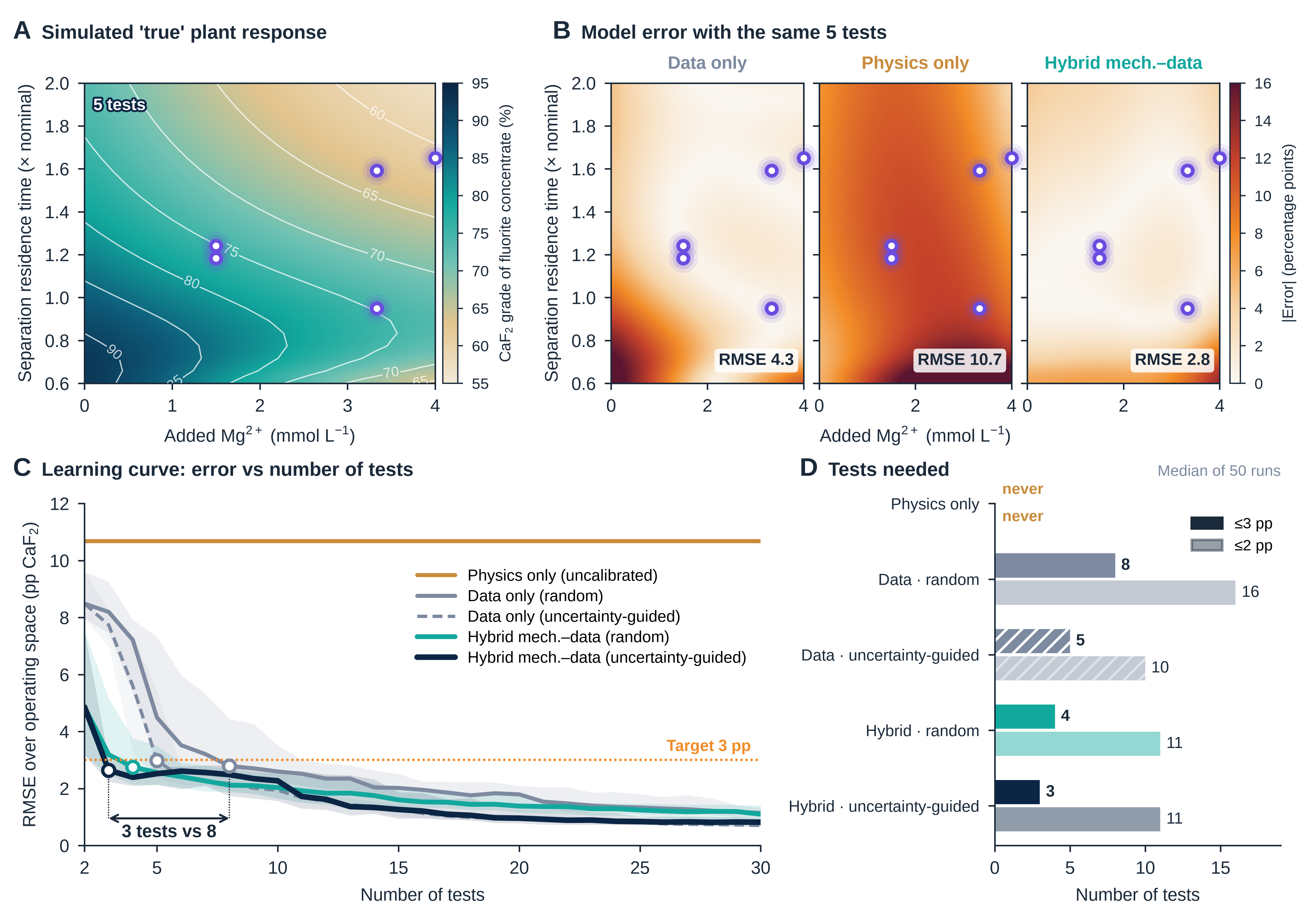
The main results are as follows. The physics-only model is not updated with tests and retains an RMSE of about 11 percentage points over the full space; it never reaches the 3 or 2 percentage point targets. Under random selection, the data-only model requires 8 and 16 tests for the median RMSE to fall below 3 and 2 percentage points, respectively; under uncertainty-guided selection the corresponding counts are 5 and 10. The hybrid mechanistic–data model requires 4 and 11 tests under random selection; under uncertainty-guided selection it reaches within 3 percentage points in only 3 tests, and within 2 percentage points in 11 tests. At about 10 tests, the accuracy of the uncertainty-guided data-only model approaches that of the hybrid model, indicating that the advantage of the mechanistic backbone is concentrated in the very-few-test regime. For an RMSE target of at most 2 percentage points, the uncertainty-guided data-only model requires 10 tests and both hybrid models require 11; the hybrid advantage is most evident under tighter sample budgets and under the at-most-3-percentage-point target. Table 1 reports the number of tests required to reach the target errors (medians over 50 repeats).
Table 1. Number of tests required for each method to bring RMSE over the operating space below the target (median of 50 repeats)
| Method | RMSE ≤ 3 pp | RMSE ≤ 2 pp |
|---|---|---|
| Physics only (uncalibrated) | never | never |
| Data only (random selection) | 8 | 16 |
| Data only (uncertainty-guided selection) | 5 | 10 |
| Hybrid mechanistic–data (random selection) | 4 | 11 |
| Hybrid mechanistic–data (uncertainty-guided selection) | 3 | 11 |
Figure 1B shows that, under the same sparse tests, the data-only model has large errors far from the tested points; the physics-only model exhibits systematic bias over the domain; and the hybrid mechanistic–data model substantially reduces error over most of the operating domain. Figure 1D is consistent with Table 1.
5 Discussion
These results indicate that, when the experimental budget is tight, using a mechanistic model as a prior backbone and correcting residuals with data improves sample efficiency; placing subsequent tests by a full-space prediction-variance reduction criterion further reduces the number of tests needed to reach a given accuracy. For difficult feeds such as low-grade ores and compositionally variable tailings, obtaining usable full-space predictions earlier helps determine reagent schemes and flowsheet parameters sooner, and concentrates costly scale-up trials on conditions that still require verification. Operating recommendations produced by the model should still satisfy process constraints such as mass balance, and should be implemented only after confirmation by specialists.
When the number of tests increases to about ten, an uncertainty-guided data-only model can reach comparable accuracy; the value of mechanistic information is mainly in sample efficiency at the beginning of the campaign.
The present results are from simulation; validation on a real plant or laboratory system remains to be done. Kinetic parameters in the simulation are illustrative, and the form of the hidden discrepancies was constructed for method evaluation; they should not be extrapolated as quantitative conclusions for a particular site.
6 Conclusion
Addressing the difficulty of predicting flotation and separation performance under scarce mineral-processing experiments, this paper outlines a basic route for Physical AI for Minerals Engineering: a mechanistic model as the backbone, a data-driven term that corrects residuals and quantifies predictive uncertainty, and sequential placement of tests by a full-space prediction-variance reduction criterion. In an emeisim simulation of fluorite recovery from tailings, an uncertainty-guided hybrid mechanistic–data model brings the full-space grade-prediction RMSE within 3 percentage points in 3 tests, outperforming a randomly sampled data-only model (8 tests); for a 2 percentage point target, the hybrid model requires 11 tests and the uncertainty-guided data-only model requires 10 tests. The approach provides a testable technical route to more reliable operating-space models under limited experimental budgets.
Keywords
Liang Jiarui
ThinkMachine · Physical AI for Minerals Engineering